Cáceres is not exactly around the corner from Barcelona.
Getting there takes time. Quite a lot of it, actually.
And yet, after spending a couple of days around Extremadura Digital Day, my main thought when leaving was: I would absolutely come back.
Not because it was the biggest conference I’ve attended, or because of some spectacular production. What stayed with me was something much simpler: how much the people organizing it seemed to care.
About the speakers. About the attendees. About the community. And, particularly close to my heart, about who gets to be part of that community.
It started before the conference
This wasn’t my first trip to Cáceres, and my relationship with this community didn’t start with EDD.
ed to Cáceres to deliver a GET /Speaking workshop with Women in APIs, one of the workshops we run to help people turn their experience into a conference proposal and take their first steps into public speaking. Daniel Castañera and Francisco Hermoso from the EDD organization helped us make it happen: finding the venue, attending the workshop, and generally making us feel welcome.
It started with a podcast between Almudena Vivanco and Julia Durán, where Julia mentioned “Why don’t we have things like GET /Speaking here in Cáceres”?. And the EDD organization helped us make it happen. They helped us find a venue, joined the workshop and, more importantly, made us feel that we weren’t simply bringing an activity to Cáceres. We were connecting with a local community.
There was another connection too. The people behind EDD used to organize DevOpsDays Cáceres, and I’m now one of the organizers of DevOpsDays Barcelona. So we already spoke a little bit of the same community language.
When the EDD CFP opened a few months later, applying felt natural. Nobody invited me to speak. I went through the CFP like everybody else. But this time I knew something about the people who would be on the other side of that submission.
And I knew exactly which talk I wanted to send them.
¿Dónde están las demás? El impacto del sesgo de supervivencia en nuestro sector.
Not because it was the safest talk to submit, but almost the opposite.
This is probably the most personal talk I give. It asks why some of us have managed to stay in tech for decades while so many others have disappeared along the way. And from what I’d already seen of this community — including the effort EDD was making to reach women through the CFP — it felt like the right place to have that conversation.
There was one more first for me: after evolving this talk for a year and a half, Cáceres would be the first place where I delivered it in Spanish.
A conference where care is visible
The organizers were incredibly attentive even before we arrived.
On Friday, a coworking space was available for those of us already in Cáceres. There was breakfast waiting for us. They took us to lunch. Later, Almudena Vivanco ran her practical workshop on chaos engineering and resilience.
These may sound like small things, but if you’ve ever organized a conference, you know what the day before looks like. There are a thousand things going wrong simultaneously.
Somehow, they still found time to look after us.
That continued throughout Saturday. The volunteers were always around to guide attendees, answer questions and make sure speakers had what we needed. Water, directions, information, help with questions from attendees… always with a smile.
Even the conference app was really useful for navigating the agenda and the venue. And what a venue.
EDD took place at the Complejo Cultural San Francisco, a conference and cultural complex built around the former Monasterio de San Francisco el Real, whose origins date back to the 15th century. Walking from one technical session to another through its historic cloisters was quite something.
The care wasn’t one big spectacular gesture. It was visible in lots of small ones.
Diversity doesn’t just happen
One of the reasons I submitted this particular talk was something EDD had done before the conference even started. The organizers had actively reached out to women’s communities to encourage people to submit to the CFP.
The result? 19 of the 25 speakers were women. That’s 76%.
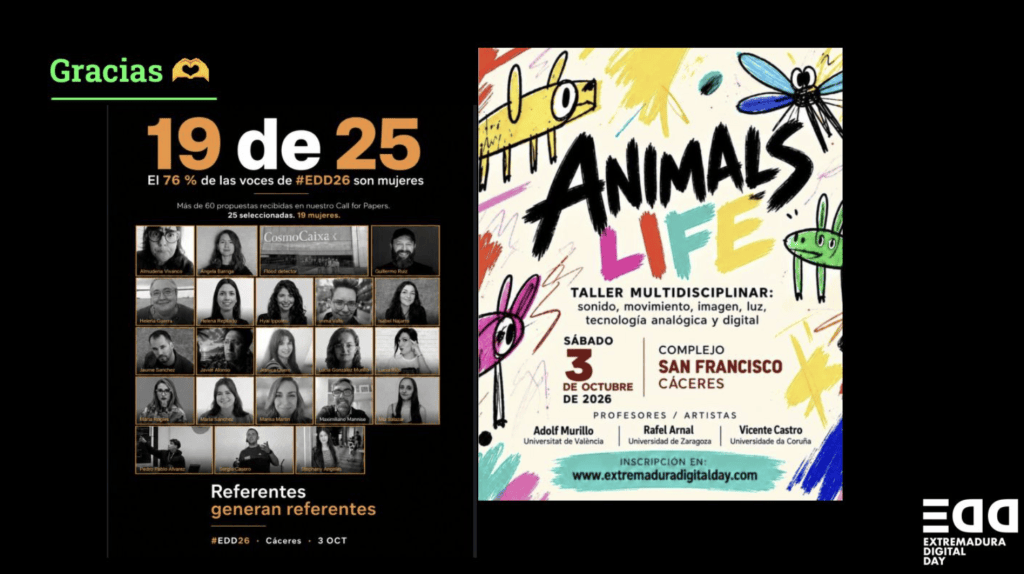
What I liked was that nobody created a special diversity track off to one side. Women were simply… everywhere. Talking about AI, performance, testing, infrastructure, careers and all the other subjects you’d expect at a technology conference.
Plenty of women were in the audience too.
This isn’t formal research, just an observation from years of attending and organizing communities. At many cloud-native and DevOps events I’ve been part of, women can still be a very small minority. I’ve also repeatedly noticed something interesting in the meetups I help organize: when women are visible among the speakers, more women seem to attend.
I don’t think we can draw a simple line of causality between those two things. But representation matters. Seeing people like you on stage makes it easier to imagine yourself belonging in the room.
EDD also thought about inclusion in other practical ways. They offered free activities for adults and children, with a STEM component, so parents could attend while their kids had something interesting to do.
Removing barriers doesn’t always require a grand initiative. Sometimes it starts by asking who isn’t here, and why?
¿Dónde están las demás?
This is probably my favorite talk to deliver. And it keeps evolving each time. The starting point is uncomfortable because it requires looking at ourselves.
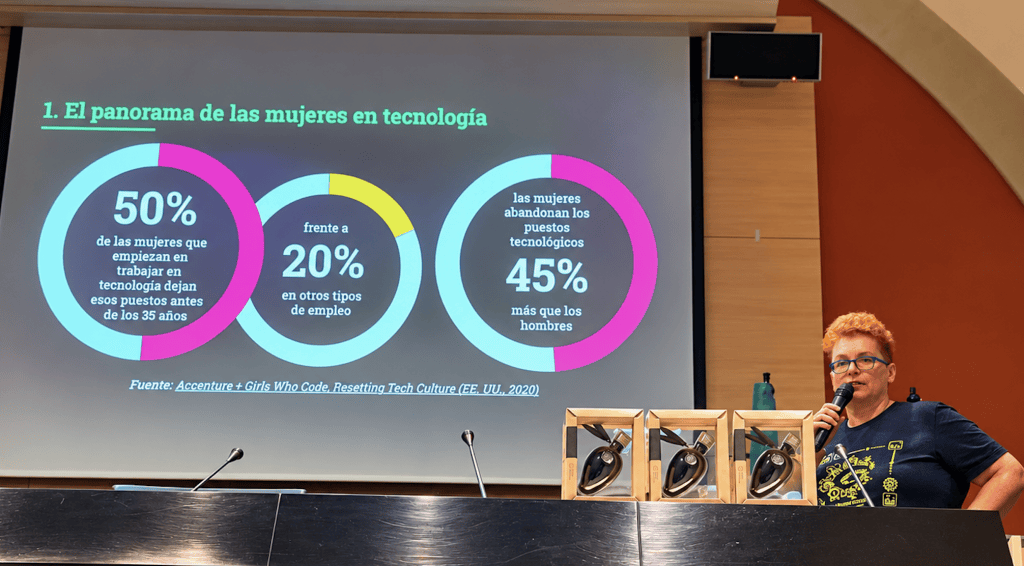
I’ve spent almost 30 years in technology. I’m still here. It would be very easy for me to look at my own career and conclude:
I managed, so other women can too.
But that’s survivorship bias. The much more interesting question is: Where are the women who aren’t here anymore? And what can I learn from their stories?
Preparing and evolving this talk has sent me on my own journey towards becoming a better ally.
Intersectionality and tools such as the Wheel of Privilege have helped me understand that my experience isn’t the experience of women in tech.
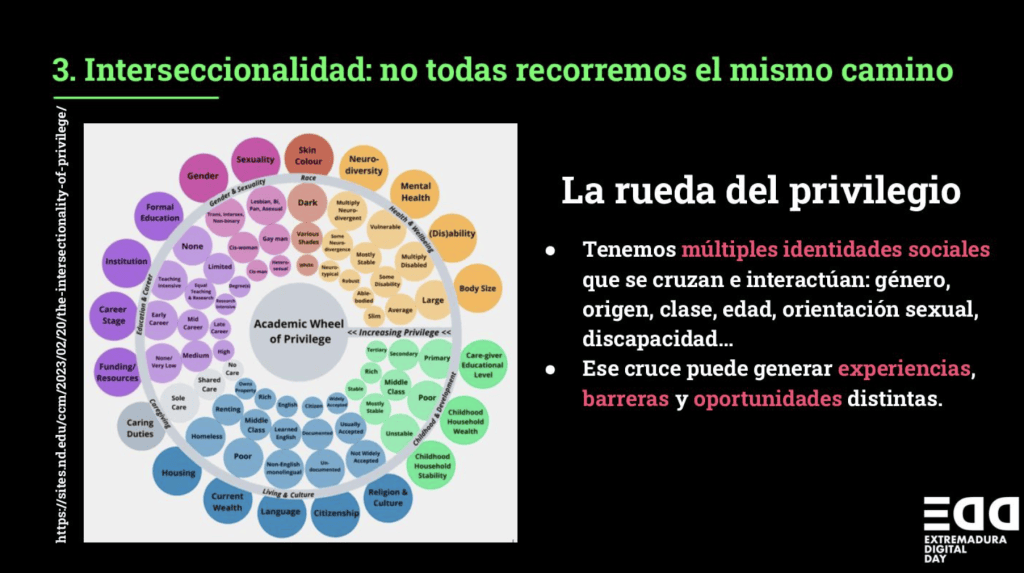
I’ve started listening much more carefully to stories that aren’t mine: migrants, career changers, women of different skin colors and backgrounds, people encountering barriers I haven’t personally experienced. That doesn’t invalidate my story. It puts it in context and helps me understand what systemic change should look like.
After the talk, several women came to speak with me. Some particularly connected with the survivorship-bias perspective. Others appreciated that I had explicitly talked about the experience of migrants. Those conversations are one of the reasons this talk keeps changing every time I deliver it.
You can find the talk and resources on my website and the full deck on Speaker Deck.
Nobody gets here alone
One of my favorite slides comes near the end. It’s a heart made of the names of people who have been my allies.
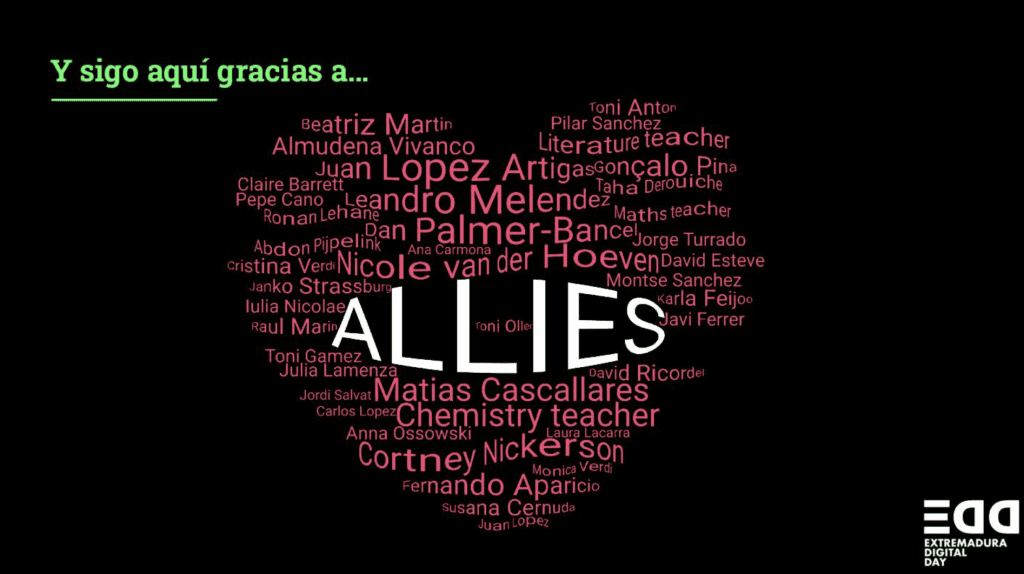
These are people who, at different moments in my life and career, helped me get here.
People who opened doors, taught me something, encouraged me, challenged me, advocated for me or simply helped me continue.
I think that matters when talking about survivorship bias. If I’m going to say “look, I survived”, I also need to acknowledge all the people and circumstances that made my survival more likely.
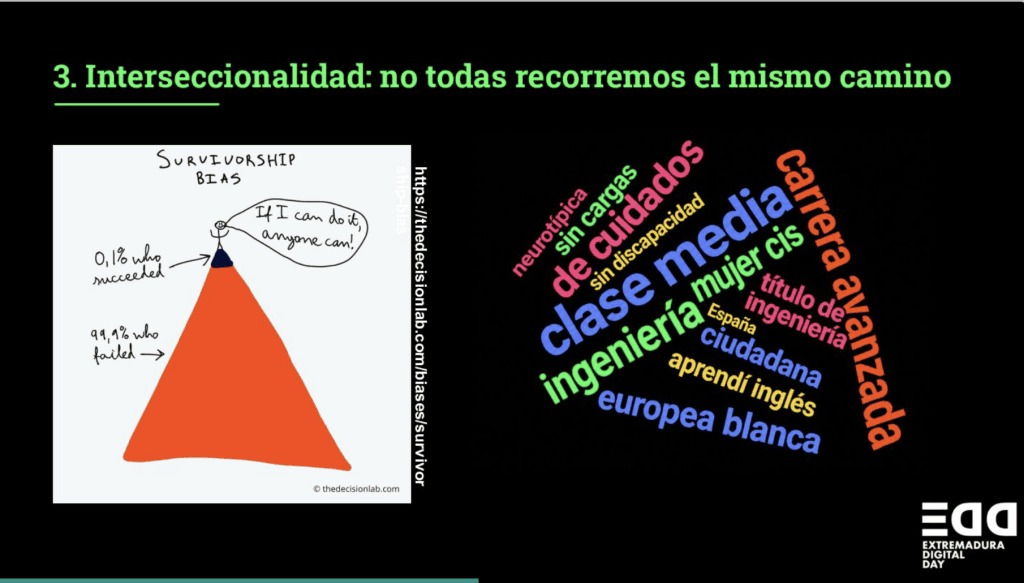
None of us gets here entirely alone.
And then four young women took the stage
One of my favorite moments of the entire conference happened immediately after my talk.
Four students presented Flood Detector, a low-cost system designed to detect rising water levels and warn communities about potential flooding.
And they didn’t come on stage with just an idea. They had built it.
They talked about water-level sensors, Arduino, LoRa communications, automated alerts, coverage and cost. They had thought about how the devices could communicate with each other and how warnings could ultimately reach people.
This was a real engineering project addressing a real problem. It reminded me of Technovation, groups of young women building tech projects for a better world.
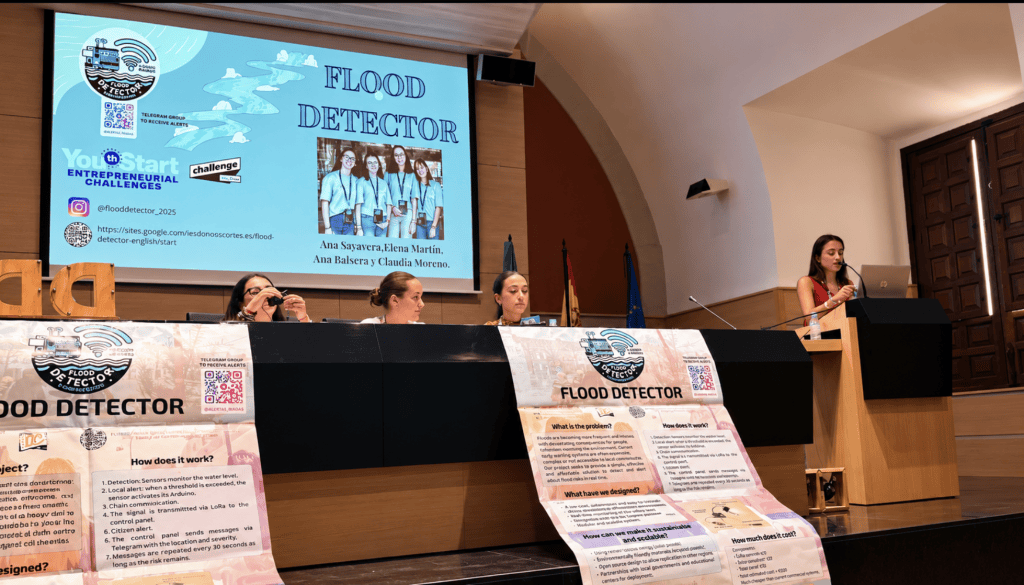
There was something particularly lovely about watching them right after spending fifteen minutes asking:
Where are the others?
Four students presenting one project at one conference obviously don’t solve the gender gap in technology. But I couldn’t have planned a better session to follow mine.
Put young women on a technology stage. Let younger kids experiment with STEM. Put women throughout the technical program. Make it completely ordinary for the people attending to see them there. That’s part of how we create the possibility of a very different answer to “Where are the others?” in the future.
I loved their project. And I loved seeing them own that stage.
And yes, there were technical talks too
I spent much of the rest of the day doing what I came to EDD to do: listening and learning.
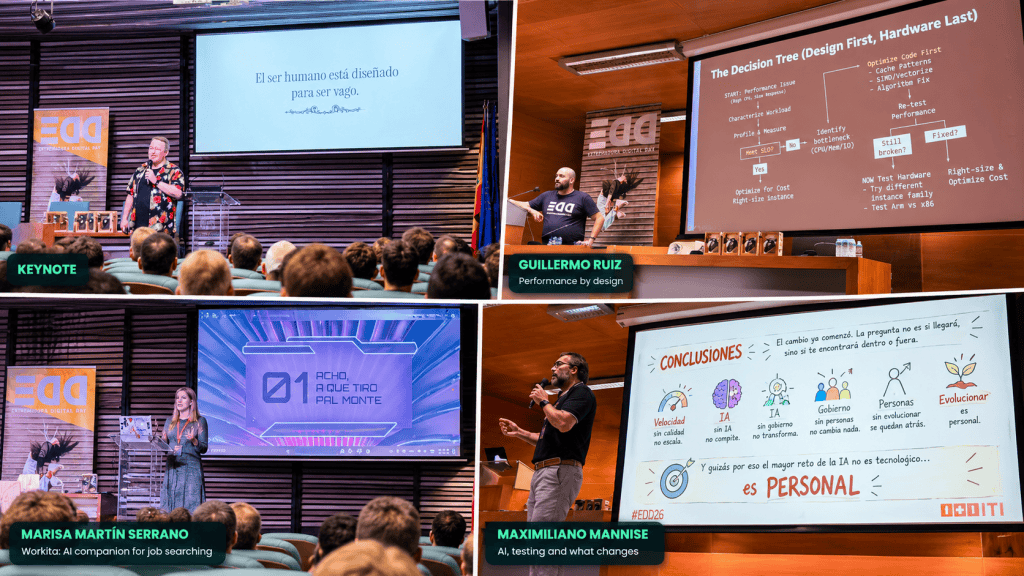
Javier Alonso Gómez opened the day with a very entertaining and deliberately provocative argument around AI agents: perhaps we need to embrace being lazy, let AI do more of the work and confront the reality that we won’t necessarily review everything it produces.
Guillermo Ruiz gave a great session on performance and why performance is fundamentally a design problem, rather than something we simply solve by throwing more hardware at it.
Marisa Martín Serrano showed Workita, the AI companion she has been building for job searching with Claude and Genkit. I particularly like talks where the speaker has actually built what they’re discussing, rather than only talking about what AI might theoretically do.
Maximiliano Mannise explored testing in the age of AI and what changes when AI becomes part of how we build software.
I would have liked to attend more sessions, but parallel tracks remain one of the unsolved problems at tech conferences.
Conferences are mostly people
Of course, the talks are only part of why I go to conferences.
I traveled there with my good friend Almudena Vivanco, caught up with brave women like Julia Durán and Guillermo Ruiz. Finally met Maximiliano Mannise in person, closing the circle!
There were conversations with María Sánchez, Marisa Martín Serrano, and even people who had attended our earlier GET /Speaking workshop. I met Mia Salazar, with whom I immediately clicked. And it looks like that conversation is going to turn into something in Madrid. And I got to spend more time with Daniel Castañera, Francisco Hermoso, Raúl Bordallo, and the people behind EDD. Particularly impressed with the EDD app that Sergio Fernández built for the conference!
That’s probably my favorite part of community events: revisiting relationships that started somewhere else while unexpectedly starting new ones.
A workshop leads to a conference. A conference conversation leads to something in Madrid. Someone sitting in an audience this year may be standing on its stage next year. I’m particularly hoping to see Julia Durán do exactly that in Valencia at VLC Tech Fest in 2027 😉
A tiny bit of Extremadura
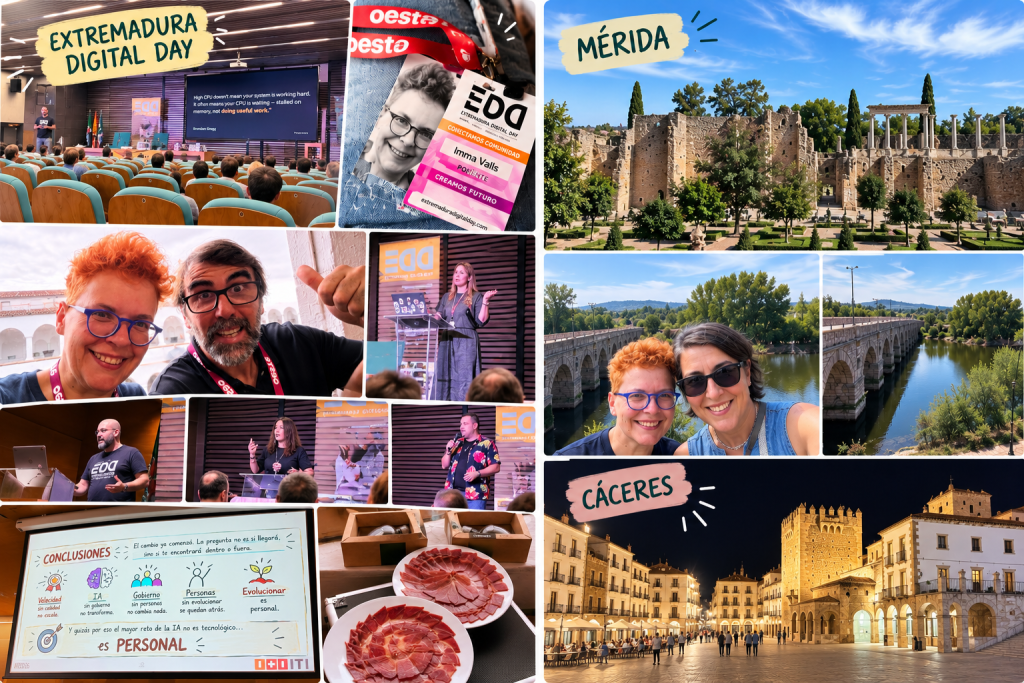
And because we’d traveled all the way from Barcelona, we couldn’t leave without seeing at least a little of Extremadura. Almudena and I managed to explore some of Mérida, including its extraordinary Roman remains and bridge. I can only thanks her for taking me there!
And Cáceres gave us a beautiful old town that deserves considerably more time than we had available.
It was enough to make me want another visit.
Although perhaps next time somebody could move Cáceres a little closer to Barcelona.
Worth the journey
I’ve been to a lot of conferences. The things I remember afterward aren’t usually the expensive ones.
I remember somebody making sure you have what you need before your talk. A volunteer smiling while solving a problem. Breakfast waiting at a coworking space. A conversation with someone you’ve just met. A room where women don’t feel unusual. School students explaining how their flood detection system communicates over LoRa.
Those things don’t happen entirely by accident. They happen because somebody cared enough to create the conditions for them.
Cáceres is a long trip from Barcelona.
I’d make it again.
Thank you to everyone behind Extremadura Digital Day, especially to the organizers and volunteers who made us feel so welcome.
See you again, I hope ❤️